How to Make Curd. Homemade Dahi Recipe. Tarla Dalal
 Tarla Dalal
• Updated : Jan 15, 2026
Tarla Dalal
• Updated : Jan 15, 2026
Curds or ‘dahi’ is a dairy product made by coagulating milk which leads to curdling. It is mostly made at home in every Indian household. Indians like to have homemade dahi any time of the day – not only with their meals but also as a snack!
The process of making full fat curds at home is very simple, all you need to do is follow proper procedure and method.


Table of Content
About How To Make Curd Or Dahi At Home

|
|
Ingredients
|
|
Methods
|
|
Method for making Curd at Home
|
|
FAQs
|
|
Related Homemade Dahi Recipe
|
|
Tips for Homemade Dahi Recipe
|
|
Nutrient values
|
We show you how to make curd. To make dahi, firstly you need to choose correct milk that is full fat milk. If you do not choose milk correctly, you will get watery dahi with excessive whey. We have started with heating little water in a pan, so that the milk doesn't burn. Rotate the pan so that the milk doesn't scorch as the water may make a protective layer, remaining water is then discarded. Then, boil the milk for 6-8 mins, allow it to cool till it is lukewarm. Once the temperature of the milk comes down, take a patila or a vessel you want to set curd in, add little full fat curd also known as jaman or starter which will help in setting the curd. Spread the curd evenly and pour the milk over it. Make sure the milk is not hot as it may lead to curdling of curd and it may not yeild creamy curd. Mix well, cover and let it rest in a warm place for 5-6 hours. After 5-6 hours, you'll find the curd set and put it in the refrigerator or else it will turn sour.
The best part is that curd is quite easy to make at home and inexpensive. It is however important to have a sample of homemade curd to make good curds as store-bought ones don’t work most of the time.
So, if you do not have curds made the previous day, try to get a tablespoon or two of it from a neighbour or good friend.
Some dishes like parathas seem incomplete if they are not served with full fat curds.. Curd is not only relished plain, but also used to make wonderful dishes like Kadhis and raitas.
Not only that, good fresh curd is essential to make chaats like Dahi Puri, Dahi Vadas, Moong Dahi Misal and Dahi Kachori too.
Check our collection of recipes using curd.
Tags
Soaking Time
0
Preparation Time
5 Mins
Cooking Time
6 Mins
Baking Time
0 Mins
Baking Temperature
0
Sprouting Time
0
Total Time
11 Mins
Makes
5 cups
Ingredients
For The Curd
- 1 ltr full fat milk
- 1 tbsp curd (dahi)
Method
Method to make curds
- To make the curd, warm the milk.
- Add the curds, mix well and cover.
- Keep aside until the curds set (approximately 5 to 6 hours). During the cold climate, place inside a cupboard or closed oven to set.
- Refrigerate after the curd have set and use as required.
How to Make Curd. Homemade Dahi Recipe. Tarla Dalal Video by Tarla Dalal
How To Make Curd Or Dahi At Home recipe with step by step photos
-
-
To make Curd at home using Buffalo milk, rinse a deep non-stick pan with 2 tbsp of water and simmer it for 2-3 minutes. This is generally done in stainless steel pans but, if you have an old non-stick pan it is advisable to make this extra effort so, that the milk does not burn. If using a stainless steel patila, you can set the curd in the same vessel.
-1-185525.webp?w=800&format=webp)
-
Rotate the pan in a clockwise motion, so the water spreads evenly in the pan. This will prevent milk from scorching as the water forms a protective layer between the pan and milk.
-2-185525.webp?w=800&format=webp)
-
Discard the water and pour the full fat milk into the pan. We have used buffalo milk here as it is a full fat milk. The higher content of fat in this milk results in a very creamy, rich and thick curd as opposed to other types of milk.
-
Boil the milk on a medium flame for 6 to 8 minutes. Stir it occasionally to avoid the milk from sticking to the bottom of the pan or browning. Generally, for making dahi at home, you just need to warm the milk slightly. In hot climate, you will need to warm the milk very slightly but, if the weather is cold you need to warm it a little more.
-4-185525.webp?w=800&format=webp)
-
Switch off the flame and allow to cool till it is lukewarm. Immerse your finger to check the temperature of the milk and then only add the starter. Do not put the milk in refrigerator to cool it quickly, it has to be cooled down at room temperature.
-
Add the full fat curd in a bowl or pan. This is called as jaman or a starter which helps in setting the curd. In winters, you would require more starter to set the curd so, adjust the quantity according to the season.
-6-185525.webp?w=800&format=webp)
-
Spread it evenly with the help of a spoon.
-7-185525.webp?w=800&format=webp)
-
Pour the luke warm milk over it. If the milk is hot and then added to curd, it will curdle and it may not yield creamy and tasty homemade curd.
-8-185525.webp?w=800&format=webp)
-
Mix well using a spoon so, that the curd spreads evenly. Sour starter will yield sour curd so, ensure your low fat curd is fresh. You can even make use of a whisk to mix the curd in milk.
-9-185525.webp?w=800&format=webp)
-
If you want to set the Homemade Curd in small containers, then transfer the mixture after the previous step of whisking into the container you want to set it in. You can set the curd in a metal container, plastic or even tiny clat pots.
-10-185525.webp?w=800&format=webp)
-
Cover with a lid.
-11-185525.webp?w=800&format=webp)
-
Rest in a warm place for 5-6 hours. During the winters, you can place the curd bowl in an oven or a casserole to set as it is considerably higher in temperature. During summers, the curd will set very quickly (within 4-5 hours), so check it after 4 hours without fail.
-12-185525.webp?w=800&format=webp)
-
After 5-6 hours, the milk will be set into curd. It will take longer if the weather is colder.
-13-185525.webp?w=800&format=webp)
-
After setting the curd | dahi | how to make curd | homemade dahi | keep it inside the refrigerator or else it can get sour taste. If you place the curd inside the refrigerator, it will get thicker and the taste will remain fresh.
-14-185525.webp?w=800&format=webp)
-
Use a spoon to check the curd if its set nicely.
-15-185525.webp?w=800&format=webp)
-
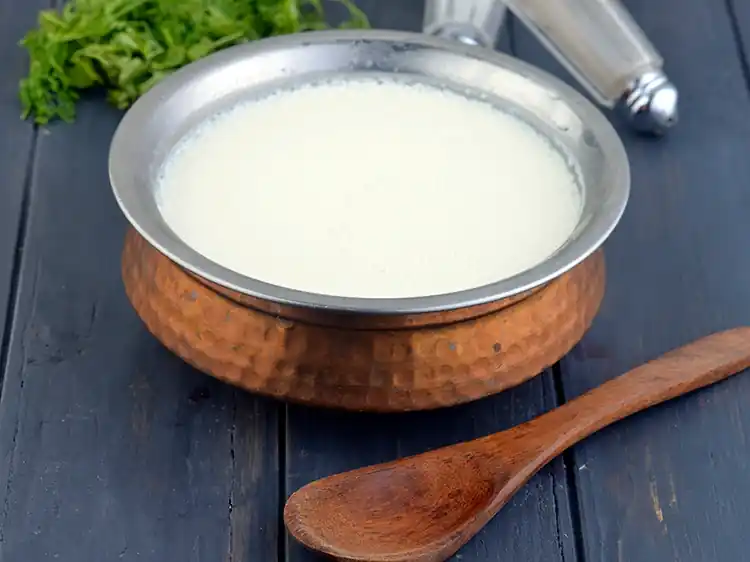
Refrigerate after the curd have set and use as required.
-
- What ingredients are needed to make curd at home?
You only need full-fat milk and curd (dahi) as a starter culture. - How much curd starter should I add to the milk?
Use about 1 tablespoon of curd (also called jaman) per liter of milk. - Do I need to boil the milk before setting curd?
Yes heat the milk and bring it to a gentle boil for 6–8 minutes, then cool it until lukewarm before adding the starter. - Why should the milk be lukewarm before adding the starter?
If the milk is too hot, it can kill the bacteria in the starter and prevent proper setting or yield a poor texture. - How long does it take for the curd to set?
Typically it takes about 5–6 hours in a warm place; in cold weather it may take longer. - Can I use store-bought curd as a starter?
Store-bought curd often doesn’t work well homemade curd from the previous day gives the best results. - Can I use any type of milk for making curd?
Yes, but whole/full-fat milk (like buffalo milk) yields thicker, creamier curd compared to low-fat or skim milk. - Where should I keep the milk while it sets?
Place the covered milk in a warm spot, like inside a cupboard or covered with warm cloth especially in colder weather. - What should I do after the curd has set?
Once set, refrigerate the curd to stop it from turning extra sour and to thicken it further. - Why does my curd sometimes turn runny or not set properly?
This can happen if the starter culture is old or weak, the milk was too hot when adding starter, or the setting temperature was too cold all of which affect fermentation.
If you liked this Homemade Dahi then also check out other recipes like:
1. Choose full-fat milk for thicker curd
Using full-fat or buffalo milk helps produce rich, creamy curd with a good set. Low-fat milk often gives runny curd.
2. Warm the milk properly before cooling
Heat the milk until it’s about to simmer; this improves texture and helps the culture work better later. Don’t rush cooling by refrigerating let it reach lukewarm at room temperature.
3. Use a fresh starter (jaman)
Always use freshly made curd (preferably from the previous batch) as the starter. Old or weak curd may fail to set well.
4. Adjust starter amount by season
In colder weather, you may need slightly more starter because bacteria work slower in low temperatures.
5. Keep the vessel warm while resting
Place the curd in a warm, undisturbed spot (like inside an unplugged oven/cupboard) to help fermentation. Avoid moving or shaking the container during setting.
6. Avoid stirring after adding starter
Once you mix the starter with lukewarm milk, cover and let it rest; excessive stirring can prevent proper coagulation.
7. Don’t open the lid while it sets
Disturbing the curd while it’s setting can result in uneven texture or slow fermentation.
8. Check temperature with your finger
Milk should feel comfortably warm on your fingertip not hot before adding starter. Too hot milk can kill the good bacteria and prevent setting.
9. Cover with a warm cloth in cool weather
If your kitchen is cold (e.g., during winter), wrap the container in a warm towel to retain heat for fermentation.
10. Move to fridge once set
As soon as curd sets, refrigerate it to stop fermentation and keep it creamy and fresh longer.
Nutrient values (Abbrv)per plate
| Energy | 238 Calories |
| Protein | 8.7 g |
| Carbohydrates | 10.2 g |
| Fiber | 0.0 g |
| Fat | 13.2 g |
| Cholesterol | 32 mg |
| Sodium | 39 mg |
Click here to view Calories for How To Make Curd Or Dahi At Home
The Nutrient info is complete

Jane
Nov. 2, 2020, 10:13 a.m.
I''d really like to try this recipe but, here in NW Spain I can''t e curds...from shops, friends of neighbours...it just isn''t known here. How can I start the process without it ? Is keffir or live yoghurt a suitable substitute. Many thanks and kindest regards from this Scottish woman in Galicia.

Tarla Dalal
Nov. 2, 2020, 10:13 a.m.
Live yoghurt will work.
Subhabrata Saha
Feb. 17, 2020, 12:34 p.m.
I used Pasteurised Homogenised Cow Milk, boiled for 5 minutes, added 1tsp curd in 500ml lukewarm milk, thoroughly mixed and then kept in a casserole so that temperature is maintained uniformly. Curd set perfectly, but too much whey. Please advise the reason and remedial measures for improvement.
Tarla Dalal
Feb. 17, 2020, 12:34 p.m.
Hi, Cows milk has more of water content, that is the reason it has more whey. Try using thicker milk.
Foodie #620322
Feb. 17, 2019, 3:26 p.m.
Love this recipe.
Healthy Eating
Dec. 27, 2010, 11:02 p.m.
Full fat curds is the healthiest snack or accompaniment you can have any time during the day. Full fat curd which is fermented milk is far healthier than low fat curd and has good protein which is particularly good for vegetarians. In addition you get calcium, magnesium and potassium, Vitamin B2 and vitamin B12. Have your curd as is or mix it with Organic Honey or make it a tasty raita by adding onions and tomato. I eat this daily and most Indian households do. But add healthy toppings to your curd! Happy cooking.