.jpg)
Also Known as
Peru, Amrood
What is guava, peru, amrood, amrud?
The delightful guava fruit is round or oval shaped, around 4-12cm long. The outer skin may be rough and bitter or soft and sweet. And depending on the variety, the skin can be thick or thin too. It is usually green when raw and becomes yellow, pink or green as it ripens. Guava is characterised not only by its unique flavour but also its dominant aroma, which pervades the whole room when cut, in ways similar to lemon rind.
You can choose guavas as per your requirement. Some people like it raw and crisp while others like it ripe and soft.
Ripe Guava
A ripe guava is soft and yields slightly when pressed. It has a strong and sweet fragrance. Depending on the variety, the flesh is white, red or salmon-coloured and flavour too varies from tart to very sweet. They are usually used to prepare jams and jellies.
Semi-ripe Guava
Semi ripe guavas are still greenish in colour and not so soft when touched. They can be enjoyed as such, plain or with a sprinkling of salt or chaat masala. They can also be chopped finely and added to mocktails.
Chopped guava
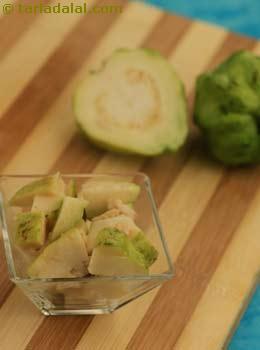
Guava should be washed very well since they tend to collect dirt. Put the washed and peeled guava on a chopping board and chop them in small 1-2 inch sized pieces with a sharp knife. They may be chopped in to big chunks or smaller ones as per the recipe.The guavas may also be chopped without peeling.
Guava cubes

Guava should be washed very well since they tend to collect dirt. Put the washed and peeled guava on a chopping board and chop them into small pieces with a sharp knife. The guavas may also be chopped without peeling.
Guava pulp
.jpg)
Guava pulp offers amazing flavour and health benefits. It can be made easily at home using any variety of guava, be it pink or white. To make pulp at home, first clean, peel and chop the guava into pieces. Blend in a mixer along with very little water into a smooth pulp and strain using a sieve to remove seeds. 2 cups of guava cubes when blended with 1/4 cup of water and strained yields approximately 1 cup of pulp. Depending on the natural taste of the guava, add sugar if required. It tastes best with pancakes or as a topping for ice-cream and other desserts. The pulp can also be used in cocktails, mocktails, and many more such dishes.
Sliced guava
.jpg)
Cut the guava in half. Slice using a sharp knife by cutting vertically across the cutting board. Slice the guava thinly or thickly as per the recipe requirement.
How to select guava, peru, amrood, amrud
• Different types of guava vary widely in flavour and seediness.
• The better varieties are soft when ripe, creamy in texture with a rind that is soft and fully-edible.
• The flesh may be white or pink.
• The aroma should be sweet and musky and not rotten.
• In good varieties, the seeds are many but small and edible.
• Select fruits that are firm and without any blemishes or soft spots.
Culinary Uses of guava, peru, amrood, amrud in Indian Cooking
On days you want to try something unique, try the easy and quick Guava Chutney. Never heard of it right? Try it and you are sure to share this healthy recipe with your friends. Avoid the ½ tsp sugar if you wish to and don’t miss out on adding a handful of mint leaves, as they are the taste enhancers of this recipe.
Healthy Guava Snack is the best to turn to at any time of the day. Always have unpeeled guava, as much of the fiber always lies just beneath the skin. The snack is nothing but guava with some chilli powder and salt sprinkled on it.
Guava is in season, and the Christmas spirit is in the air. This means its time to make
Guava Cheese! A famous sweet made during Christmas time, the Guava Cheese is much-loved by kids and adults because it has a fabulously fruity flavour with a mild lemony tinge! It takes a little time to make but is completely worth the effort.
Guava is in season, and the Christmas spirit is in the air. This means its time to make
Guava Cheese! A famous sweet made during Christmas time, the Guava Cheese is much-loved by kids and adults because it has a fabulously fruity flavour with a mild lemony tinge! It takes a little time to make but is completely worth the effort.
• Guava can be eaten as it is, plain or with seasonings like salt, chilli powder or chaat masala.
• The fruit is also prepared as a dessert.
• In Asia, fresh raw guava is often dipped in preserved prune powder or salt.
• Because of its high pectin content, boiled guava is also extensively used to make candies, preserves, jellies, jams, marmalades and also juices.
• Guava juice can be used in mocktails.
• Slices of guava are used in ice-creams, sorbets, salads and yoghurt to get a distinct flavour.
How to store guava, peru, amrood, amrud
Guavas continue to ripen after harvest, but like most tropical fruits they must be stored at room temperature and not refrigerated unless overripe.
Nutritional Information of Guava, Peru
Nutritive Information for Guava:
1 Cup of chopped guava is about 130 grams
RDA stands for Recommended Daily Allowance.
Energy - 66 calories
Protein – 1.2 g
Carbohydrate – 14.6 g
Fat – 0.4 g
Fiber – 11 g
Vitamins:
0.04 mg of Vitamin B1 (Thiamine) = 2.7% of RDA ( (about 1.2 to 1.6 mg for men)
0.04 mg of Vitamin B2 (Riboflavin) = 2.1% of RDA (about 1.4 to 1.9 mg for men)
275.6 mg of Vitamin C = 689 % of RDA (about 40 mg)
Minerals:
13 mg of Calcium = 2.2% of RDA (about 600 mg)
0.4 mg of Iron = 2% of RDA (about 20 mg)
36.4 mg of Phosphorus = 6.1% of RDA (about 600 mg)
31.2 mg of Magnesium = 9.2% of RDA (about 340 mg)
118.3 mg of Potassium = 2.5% of RDA (about 4700 g)
Health benefits of guava, peru, amrood, amrud
1. Low in Carbs: Guava is Low Carbs and hence a very healthy sweet fruit to eat.
2. High in Vitamin C : Guavas are often marketed as super fruits, being rich in Vitamin A and Vitamin C. It has 4 times the Vitamin C level than Oranges.
3. High in Fibre : One Guava contains 9 grams of Fibre which will keep your stomach fuller for a longer time. It will also help you with your digestion and prevent constipation.
4. Powerful Antioxidant : Guava helps the body get rid of harmful free radicals in the body. We all have Antioxidant and free radicals in our body at all times. By eating foods that are rich in Antioxidants helps counteract the harmful effect of free radicals. This helps us slow down the process of ageing, providing better skin amongst many benefits.
5. Diabetic Friendly : Guava is low in calories and helps lower blood sugar levels in the body. As its rich in Fibre, you will feel fuller for a long time.
6. Good for Eyes : Guava is rich in Vitamin A which helps your eyes and slows down the formation of cataract and degeneration of your eyes.
7. Fights Cancer : Being a powerful antioxidant Guava reduces the effects of free radicals and hence fights of cancer.
8. Good for Heart : Since Guava is low in fat and Cholesterol free you should be consuming it.
9. Potassium Rich : It is also a good source of Potassium, which helps to maintain heart rate and blood pressure.
10. Controls Blood Pressure : Being high in fibre and low in calories, Guava reduces the cholesterol in the blood and prevent it from thickening resulting in Lower Blood Pressure by making it free flowing.
Glycemic Index of Guava
Guava has a Glycemic Index of 12 which is low. Glycemic Index are for foods you eat, ranks carbohydrate-containing foods by how quickly they digest and raise your blood sugar or glucose levels. Foods rank from 0 to 50 are low GI, 51 to 69 are medium and 70 to 100 are high. Foods that are high in GI are not suitable for weight loss and diabetics. Foods like Guava have a low GI and hence don't spike your glucose level as they are absorbed slowly. Great for weight loss.